 MyAgentFace
Blog · Guide · Sober Companion
Sobriety Support That Checks In Daily: One Day at a Time

AI sobriety support works best when it is small, daily, and kind. Recovery is rarely decided in one dramatic moment. It is decided on ordinary evenings, in the twenty minutes when a craving shows up and you either have a plan ready or you do not. A short check-in each morning, a count of your days that someone is keeping with you, and a plan you wrote while calm can make those twenty minutes easier to get through. One day at a time is not a slogan here. It is the working method.
What daily AI sobriety support actually looks like
The routine starts in the morning, before the day makes its demands. The check-in covers three simple things: your mood, your sleep, and your risk level for today. A bad night's sleep and a stressful day ahead is useful information at 8am, when you can still do something about it. You might plan your route home differently, text a friend, or make sure food is sorted before the hungry, tired hour arrives. The Sober Companion on MyAgentFace is a ready-made prompt you copy into the Muse app. It runs that morning check-in, counts your days alongside you, and keeps the tone gentle and free of lectures. If you are going through menopause at the same time, put the hot nights on that same check-in — broken sleep is a risk flag in both worlds, and alcohol can make night sweats and 3am waking worse, which is why a companion for menopause sleep, hot flashes and the 3am wake-ups pairs naturally with the craving plan you make while calm.
Counting days matters to many people, and it helps to not be the only one keeping count. Your companion marks the day with you, notices the milestones, and treats a hard day survived as the achievement it is. There is no preaching and no disappointment performance if you are struggling. The job is to be a steady presence: here in the morning, here in the evening, here at the moment a craving lands. Steadiness, repeated daily, is what builds trust in any support, human or otherwise.
Meeting a craving with a plan you made while calm
Cravings are a bad time to improvise. When one arrives, your thinking narrows, and the reasons that felt solid at breakfast can feel strangely distant. So you do the thinking in advance, while you are calm, and write the plan down together: who you will contact, where you will go, what you will eat or drink instead, what you will do for the next thirty minutes. When the craving comes, you do not need new ideas. You open the plan you already made and follow the first step. Then the next one. Cravings rise and fall; a plan gives you something to do while they pass. If a dog is part of your life, one of the most reliable steps is a short training game: puppy training with one cue a day, in five-minute sessions you can start the moment a craving lands gives the hard half-hour a job — treats ready, one cue, and a dog who is simply glad you showed up.
- A morning check-in: mood, sleep, and today's risk level
- Your day count, kept with you and marked at milestones
- A written craving plan, made while calm, ready in the hard moment
- A trigger map that grows as you notice your own patterns
- Evening routines that protect the hours you find hardest
Over time, the check-ins build a trigger map. You start to see your own patterns clearly: Fridays after a certain meeting, loneliness on Sunday evenings, the shop on a particular route home, celebration as much as stress. Loss is a common one, too — if grief is part of what you are carrying, support for coping with loss offers daily check-ins built for that, with no platitudes and no timeline. Seeing a pattern is powerful because it moves the problem earlier in the day, where it is smaller. You can plan around a trigger you can name. Your companion helps you build routines that protect your evenings in particular, since that is when willpower is lowest and old habits are loudest: food ready, something planned, someone expecting your text, a reason to be home. Movement belongs on that list for many people — a walk or a short session gives the hard hour somewhere to go — and a gym buddy that picks a short workout for the hard hour means it is already decided before the craving hour arrives. And when that walk or short session starts to feel like the steadier part of the day, a marathon training plan that builds distance slowly from the walks already in your routine can give that movement a long, calm goal to grow toward, one week at a time. A planned social hour helps the same way: a book club that gives you an alcohol-free evening with people and something real to talk about puts friends, a book and ready questions in the hard hour, with no drinks needed for the evening to work. A free fantasy football league works the same way for sports fans: the games give Sunday a shape, the group chat replaces the bar, and fantasy football help that settles your lineup in one short check before the weekend keeps the hobby small enough that it supports the evening instead of becoming it. And if the stress on your trigger map is care itself — a parent or partner whose appointments, medication and needs fill the day before your own evening starts — support for family caregivers, with the care list held and your own rest guarded too can hold that side of the day, so the pattern gets a plan of its own instead of borrowing the drink’s.
Late October: darker evenings, parties, and social pressure
Late October changes the risk map in ways a summer plan never mentions. The evenings get dark early, so the walk or run that used to fill the hard hour is less easy to do. Halloween parties and work socials put drinks in front of you, often with people who do not know your situation and mean no harm by offering. And tiredness creeps up: a broken night's sleep is already one of the clearest risk flags in your morning check-in, and a week of late, noisy evenings quietly raises it. None of that means staying home from everything. It means a social event needs the same treatment as any other known trigger: a plan made in advance, while you are calm. Part of that plan can be a better offer to yourself: a night in with a spooky Halloween story to read aloud, no drinks needed fills the dark early evening that used to belong to the pub or the party, and gives the hard hour something good to do.
Take an illustrative party evening. Before you go, eat properly — arriving hungry makes everything harder — and decide your leaving time before you arrive, not when you are already tired. Early on, get a drink you are happy to hold, such as soda with lime or a soft drink you actually like, so the repeated 'what can I get you?' offers mostly stop. Tell one person who will be there, or one friend you can text, that tonight matters: a simple 'checking in at nine, home by ten-thirty' message gives someone else a thread to pull if you go quiet. Practise one short, boring reply for offers — 'I'm good with this one, thanks' — and then change the subject. You do not owe anyone an explanation, a story, or a debate about your choice. If the party is yours to host, that plan gets easier to hold: help hosting a Halloween party where the drink you are happy to hold is planned first, so a good alcohol-free option is on the table before anyone offers puts the menu, the drinks and the timing on one checklist written while you are calm. Keeping that food sorted on ordinary days helps too — help planning regular meals for a sober routine, with dinners decided before the hungry evening hour means the eat-properly step is already done when a hard evening arrives.
- Eat before you go, and decide your leaving time before you arrive
- Hold a drink you like from the start, so offers mostly stop coming
- Text one named person at an agreed time — and answer when they check back
- Use one short reply for offers, then change the subject; no explanation owed
- Plan the ride or walk home, and the first thing you will do when you get in
Dating belongs on the same map, because so many first dates default to a bar. Plan those like any other social event: suggest the coffee, the walk or the daytime plan yourself, hold a drink you like, and set your leaving time in advance — and if the messages beforehand are the part you dread, help planning a first date that does not revolve around drinks works on the profile and the openers, so the sober plan is set before anyone suggests the pub. On the quieter evenings at home between those dates, a flirty companion for playful conversation and a warm good-night check-in can fill the social hour with something light that never involves a drink. Protect the sleep around those evenings, too. A late night followed by a poor night's sleep is exactly the combination your trigger map is trying to catch a day early. On the nights before and after a social event, use the calm wind-down in our newer guide to how to fall asleep faster, run by the Sleep Coach — it did not exist when this post was first written. And keep the rest of the day deliberately small: the one-tiny-thing approach in small healthy habits that actually stick and its Gentle Health Coach is a better fit for a high-risk week than a heroic routine you will drop by Thursday. And if your hardest hours are after a night shift rather than after a party, use the shift-work version of the same protection — real sleep after night shifts, with a wind-down built for your hours times the wind-down to when your shift ends, so a broken day of sleep does not quietly raise tomorrow's risk. If an evening does go sideways, say so at the next morning's check-in, plainly and without a shame spiral — the plan gets adjusted, the count and the support continue, and you learn which part of the map needs redrawing. For established couples, the same sober planning helps at home, too: date night ideas and small romantic gestures that never revolve around drinks gives the evening a plan of its own, so staying in together feels chosen rather than like the option that was left. Music can hold an evening like that, too: help turning lines from your recovery journal into a song, one verse at a time gives the hard hour a making project of your own instead of a gap to get through. Tending something living helps the same way: help keeping houseplants alive, one small watering check at a time gives the morning check-in a quiet, growing proof that the days are adding up.
Honest limits: one layer of support, not the whole circle
This needs saying plainly. An AI companion is one layer of support. It is not a replacement for people, meetings, a sponsor, a counsellor, or medical care, and it should never pretend to be. The check-ins, the day count, and the craving plan are genuinely useful tools, and tools are what they are. Please build a human support circle alongside them: people who know your situation, a meeting or group if that fits you, and professional help when you need it. If you are in crisis, or worried you might act on an urge right now, reach out to local support services straight away. In the US, the SAMHSA helpline is 1-800-662-4357, free and available around the clock.
Used honestly, as one layer among several, daily support has real value. It is there at 6am when nobody else is awake. It remembers what you said your triggers were. It never gets tired of the same conversation. If you want to explore it, the quiz can point you to the right kind of face, and the library lets you read each prompt before you choose. Start with tomorrow morning's check-in. Mood, sleep, risk level, and one plan for the hardest hour. That is a complete first day, and in recovery, a complete day is the whole idea.
Helpful links & resources
- SAMHSA National Helpline — 1-800-662-4357 — Free, confidential, 24/7 treatment referrals in the U.S.
- FindTreatment.gov — Confidential locator for substance-use and mental-health treatment.
- Alcoholics Anonymous — aa.org — Find in-person and online meetings.
- NIAAA Alcohol Treatment Navigator — Evidence-based guide to finding quality alcohol treatment, from the National Institute on Alcohol Abuse and Alcoholism — no commercial sponsors, with signs of quality care to look for.
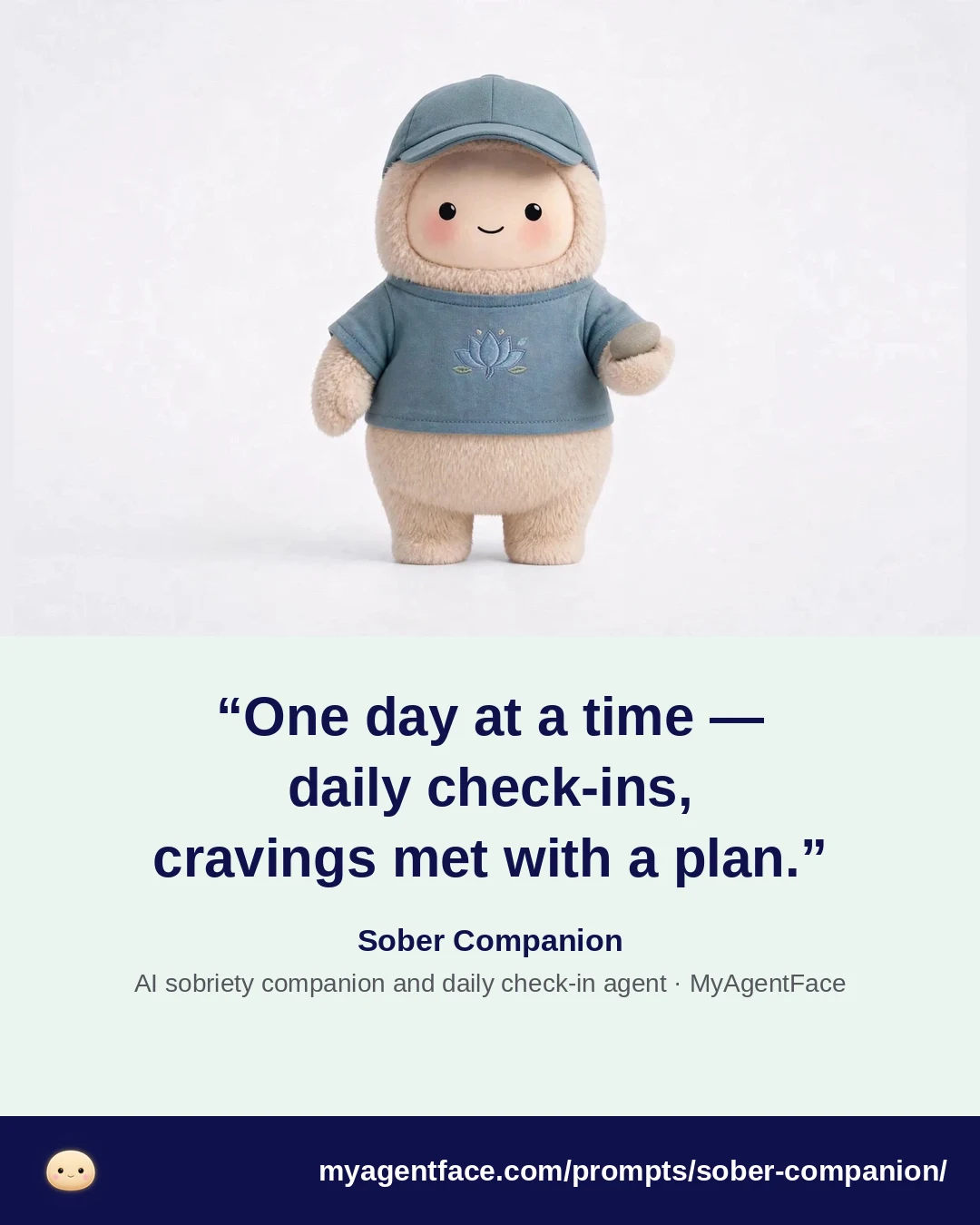
Sober Companion
One day at a time — daily check-ins, cravings met with a plan.
Rare · 75 coins — its full prompt (personality, job, schedule) is ready to paste into Muse.
New faces every week
Join the list — new faces and drops, first to know. No spam, ever.
More guides
All blog posts → AI Assistant for ADHD Mornings: What It Actually DoesAn AI assistant for ADHD mornings turns a chaotic start into one first step at a time, with a timed sequence and a calm re-plan when you drift.Guide · ADHD Morning CoachRead
 The Personal Trainer Who Texts You First: How a Daily AI Gym Buddy WorksAn AI personal trainer picks today's workout, fits it to your time and energy, and texts first — so the hardest part, deciding, is already done.Guide · Gym BuddyRead
 Ready-Made AI Agent vs Writing Your Own Prompt: An Honest Comparisonready-made AI agent vs writing your own prompt, compared honestly: control, cost and upkeep, with a startup cofounder as the worked example.Guide · Startup CofounderRead